


Building a successful company is a dream for nearly every entrepreneur, but receiving an award from the White House for positively impacting society and the economy is seemingly unthinkable. However, Zack Rinat, co-founder of NetDynamics, Trading Dynamics, and Model N, has been able to achieve both of these tremendous accolades. Rinat has successfully established and sold multiple businesses throughout his career and has learned how to properly develop a company’s culture. For Rinat, culture comes down to four core values that fit nicely into the acronym DARE: dream, align, respect, and excel. These values should permeate the entire business, and it is the responsibility of the founders to explicitly emphasize these principles to all employees. Rinat spoke to 20MinuteLeaders creator Michael Matias abut why it is extremely important to him to give back to society, and helping his community flourish whether by creating new jobs or encouraging social entrepreneurs in their ventures.
Click Here For More 20MinuteLeaders
Who are you as an entrepreneur?
Before coming to Silicon Valley in 1990, I worked on a project to develop a jet fighter known as The Lavi in Israel. I was working on their flight control computer before the Israeli government canceled the project. The project cancellation made me realize that I wanted to control my destiny, and I figured entrepreneurship was the way to do that. In 1995, I co-founded a company called NetDynamics, which created the market for application servers. The company was enormously successful and was acquired by Sun Microsystems, which was later acquired by Oracle. Our work is known right now as the standard and is called (JEE) Java Platform Enterprise Edition. Then I later helped a friend of mine, Yoav Shoam, to start a company called Trading Dynamics, which was a pioneer in business to business auctions. The company was in business for about 18 months and then got acquired by Ariba. I was then the chairman of the board of Conduit Conduit (NASDAQ), which split into a privately held company and also to a publicly held company through a reverse merger with a company called Perion Network.
But my longest endeavor is with a company called Model N that we founded in 1999, where I’m now the executive chairman. I’m now also the president of the DARE (Dream. Align. Respect. Excel) Foundation
How much value did you bring into the world economy through these different endeavors?
What’s important for me is the number of jobs that we create both in the U.S. economy and in the global economy. In the last 25 years, my companies have created tens of thousands of jobs, which led to my recognition by the Obama administration as a champion of change — entrepreneurs that create jobs in the economy.
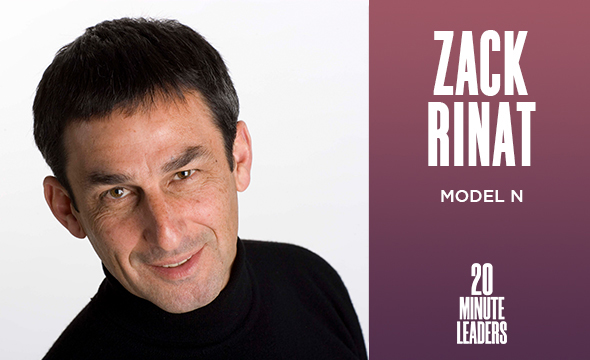 Zack Rinat. Photo: Courtesy
You also enjoy taking time off by attending events like Burning Man.
Yes, I love the Burning Man event, and it’s become a way of life for me. Burning Man to me is a lesson in leadership; it teaches you that if you’re working with a large group of people and you set values and you exemplify them that magic can happen. That’s the same philosophy that you have when creating a company’s culture.
What are your two cents on creating culture and how do you go about doing it?
I believe that culture needs to be explicit because implicit culture is subject to different interpretations. Secondly, you can create culture from the outside in by knowing what your culture will look like in the future, or you can create it from the inside out. I believe in the latter because the foundation for culture is values. You need to examine what your values are since change, like values, are constant.
How do you make culture explicit?
In my companies, for example, culture comes down to four core values: Dream, Align, Respect, and Excel. In all the companies that I’ve run, I have always interviewed the first 250 people myself because if you get the management team right, magic happens. It is important to hire people that exemplify your culture and examine candidates’ core values in the hiring process. The founding team also needs to understand what they stand for because if the founding team members do not believe in the same values, then it is not a good founding team. It’s also something that you promote. For example, every year in the company we select one person that best exemplified our core values, and we gave them a pretty significant amount of stock in the company. It’s also important to remember that culture comes into play when you need to make tough decisions and not only when everything is peachy. That’s when you test culture because then you’ll need to make painful trade-offs.
How did you take this concept of DARE and then transition it into a non-profit movement?
I transitioned into social entrepreneurship to give back what I got in terms of experience, network, and resources. The concept of DARE was inspired by the Israeli Defense Forces slogan: “Who Wins Dares.” The DARE Foundation seeks to make bold social change and encourage social entrepreneurs to take risks and to make a difference.
Describe yourself in three words.
Who dares, wins.
 Michael Matias. Photo: Courtesy
Michael Matias, Forbes 30 Under 30, is the author of Age is Only an Int: Lessons I Learned as a Young Entrepreneur. He studies Artificial Intelligence at Stanford University, while working as a software engineer at Hippo Insurance and as a Senior Associate at J-Ventures. Matias previously served as an officer in the 8200 unit. 20MinuteLeaders is a tech entrepreneurship interview series featuring one-on-one interviews with fascinating founders, innovators and thought leaders sharing their journeys and experiences.
Contributing editors: Michael Matias, Amanda Katz
Recent Comments