

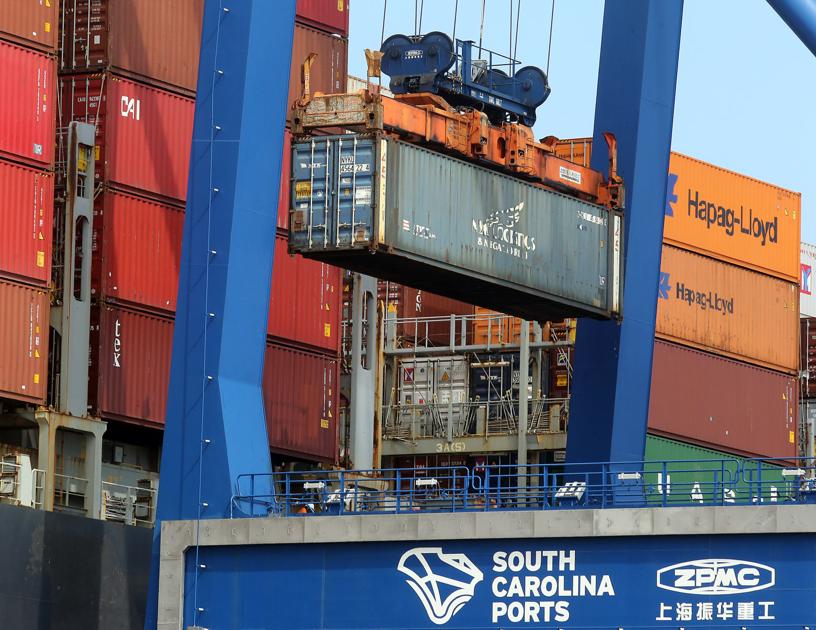
It’s fairly easy to predict the impact COVID-19 will have on cargo volumes at the Port of Charleston over the next few months: A substantial dip as the virus continues to spread through Europe and North America followed by a corresponding rebound as supply chains replenish.
What isn’t so clear is the long-term impact the pandemic will have on U.S. consumers.
“We would expect a 15 percent to 20 percent shortfall in volumes in March and April accounted for by a lot of (canceled) sailings in Asia and the fact that the Asian factories have really only come back to work 100 percent (last) week,” said Jim Newsome, president and CEO of the State Ports Authority. “That seems to be materializing as we thought with the idea that maybe April is going to snap back a little quicker. We are getting some anecdotal evidence of people who have a lot of shipments on the water …” that will lead to higher volumes in May and June.
“I think longer term we have to know what is happening with the U.S. economy consumption-wise,” he said.
The early indicators are not good. Factories, restaurants and other businesses are suspending production or shutting down entirely, which means workers in those industries will face layoffs or furloughs and have fewer dollars to spend. Events are being canceled and fewer people are choosing to fly as the U.S. government issues travel warnings.


“This is unusual in that it may prove faster acting than past downturns,” Jay Shambaugh, director of the Hamilton Project at the Brookings Institution, told The New York Times. “The drop in oil prices and drop in financial markets alone, and when you add those to the impact of the virus and the hit to global demand, at some point that has spillovers to the U.S. economy.”
Ian Shepherdson, chief economist at Pantheon Macroeconomics, told clients last week that second-quarter growth domestic product is expected to drop 10 percent on an annualized basis. That’s after a 2 percent decline in the first quarter.
“Discretionary consumers’ spending — that is, consumption excluding housing, health care, food and energy — accounts for some 39 percent of GDP, and some of the major components are set for massive second-quarter meltdowns,” Shepherdson told clients, according to a Yahoo! Finance report.
Less demand means fewer cargo boxes full of consumer goods moving through the Charleston port’s terminals. But the ultimate impact is impossible to predict until the coronavirus is under control and consumers feel confident enough to venture out of their homes.
A quick, but small, measure of the impact can be seen in the cruise industry, which recently put a 30-day moratorium on voyages, including those from Union Pier in downtown Charleston. The authority typically earns about $700,000 per month from pleasure ships like Carnival’s Sunshine — a fraction of the profit realized from container ships.
Newsome said the Port of Charleston will continue to operate as normal, but the SPA is taking some steps to keep its workers safe.
All discretionary events and most travel have been canceled. Staff is ramping up cleanliness efforts. The port policeman at the authority headquarter’s front desk in Mount Pleasant, for example, is sanitizing the doors every hour. Workers have been asked to maintain “respectful distances” from each other. And many external visitors are being asked to call instead of visit in person.
“We’ve learned we can do a lot by phone, I guess that’s the best way I can put that,” Newsome said.
Volvo recall
Volvo Cars is recalling several models because the automatic emergency braking system might not detect obstacles and stop the vehicles as designed.
The recall includes 2019 and 2020 V60, S90L and V90 models as well as the S60 sedan Volvo builds at its $1.1 billion manufacturing campus off Interstate 26 near Ridgeville.
The company says in government documents that a software-hardware incompatibility glitch causes the problem, according to an Associated Press report. If the system doesn’t work as intended, it can increase the risk of a crash, Volvo said in documents posted on the National Highway Traffic Safety Administration website.
“This is a global recall and affects most cars assembled around the world in 2019,” Volvo spokesman Jim Nichols told The Post and Courier. “There have been no injuries or crashes as a result of this issue and Volvo Cars is being proactive out of an abundance of caution. Customers will be notified if their vehicle is affected and can take their car to a Volvo retailer for a complimentary software upgrade.”
Reach David Wren at 843-937-5550 or on Twitter at @David_Wren_
Recent Comments