


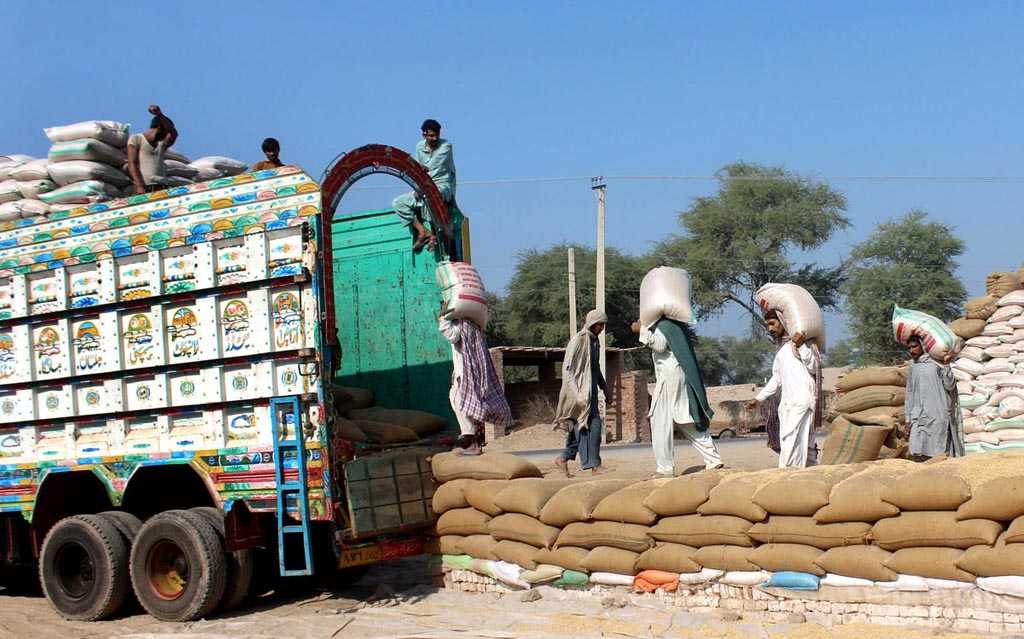
MULTAN: December 03 – Labourer busy in loading wheat bags on the delivery truck near Adda Band Bosan. APP photo by Tanveer Bukhari
The inaccurate data by the provincial governments with respect to damage caused to wheat crop 2018-19 and non-procurement of wheat by Sindh government are the main reasons behind the wheat and flour crises in the country.
Dr Muhammad Hashim Popalzai, Secretary Ministry of National Food Security and Research while briefing Senate Standing Committee on National Food Security and Research, presided by senator Syed Muzaffar Hussain Shah, said that the provincial governments had informed the Center that rains damaged 1.2 million tons of wheat across the country while the actual damaged caused by rain was over 2 million tons.
“The provincial governments had not only shared inaccurate data but also shared it with his ministry very late,” he said. He said that provincial governments shared final data regarding damages caused by rains to wheat crop in November 2019 instead of June and July.
He said that the provincial governments only shared data regarding area and production and reported nothing about quality of wheat. He further said that in Punjab, wheat harvesting start in mid-April therefore they need to share final data with respect to production till June. In Sindh, wheat harvesting start in mid-March therefore they should share final data till June, he said.
Popalzai said that non-procurement of wheat by the Sindh government was another major reason of wheat crises.
A senior official of Sindh food department told the committee that the food department had submitted proposal before Sindh the cabinet regarding wheat procurement but it was not considered. Due to non-procurement of wheat by the Sindh government, the surplus wheat available in the market was purchased by private sector and shifted to other provinces, he said, adding that quality of wheat in Punjab and Khyber Pakhtunkhwa was not good because of attack of yellow rust due to which surplus commodity was shifted there.
Imran Nasir Khan, Managing Director (MD) Pakistan Agriculture Storage and Services Cooperation (PASCO) told the committee that government allowed PASCO to release 1.10 million tons wheat to provincial governments including 0.45 millions for Khyber Pakhtunkhwa, 0.40 million tons to Sindh, 0.050 million for Balochistan and 0.20 million tons for Utility Store Cooperation (USC).
Against the allocated quantity of 1.10 million tons provincial governments and USC have so far lifted 0.5088 million till January 29, 2020, whereas 0.591 million tons is required to be lifted, he said.
He said that the delay in lifting wheat by Sindh government is another reason for crises. “On one hand, Sindh government did not procure wheat and on the other, it did not lift wheat from PASCO on time,” he said.
When committee asked Popalzai about current wheat stock in the country, he said that the current wheat stock as of today is 3.2 million tons. Out of total stock of 3.2 million tons, wheat stock in Punjab is 1.9 million tons, in Sindh 0.35 million, Khyber Pakhtunkhwa 0.16 million tons and Passco has 0.84 million tons, he said.
He said that total per day consumption of wheat flour in the country is around 40,000 tons therefore country will consume 2.4 million tons in the next two months (February-March).
Senator Sajjad Hussain Turi said that if the current wheat stock in the country is 3.2 million and total requirement of the commodity for next two months (February-March) is 2.4 million as well as new crop of Sindh will arrive in mid-April then there is no need to import wheat.
On this, Popalzai said that wheat crop of Sindh will arrive in mid-April but unless Punjab arrives, the whole scenario will come under control.
About import of 300,000 tons, he said that the government has removed 60 percent regulatory duty and directed his ministry to study the removal of six percent withholding tax on import of wheat.
Following complete study, it was found that it is a part of act and his ministry can not remove it. His ministry requested Economic Coordination Committee (ECC) to direct the Federal Board of Revenue (FBR) to issue an “ordinance” in this regard.
He said that following announcement of wheat import, different importers showed interest in import of wheat and submitted their papers with the Department of Plant Protection (DPP) but they withdrew them due increase in international prices of wheat, decrease in wheat prices in the country due to different measures and arrival of wheat crop in Sindh on March 15.
Following withdrawal of papers by the importers, his ministry opted to engage Passco for import of wheat or import wheat via land route from Kazakhstan because wheat from there can be arrived within 15 days.
When the committee chairman said that it means no progress has been made with respect to import of wheat, Popalzai said that practically import of wheat is still under process.
Recent Comments