

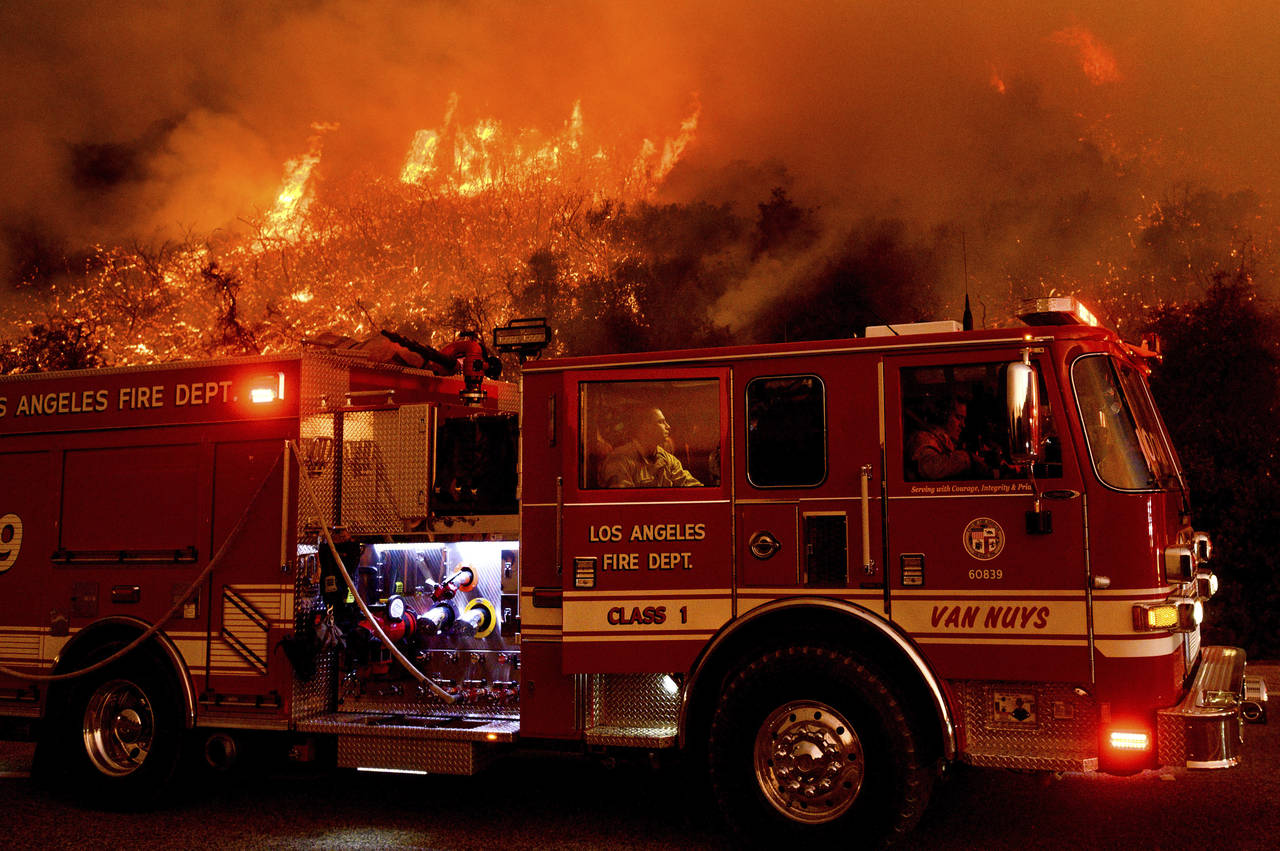

FILE – In this Nov. 26, 2019, file photo a firefighter prepares to battle the Cave Fire as it flares up along Highway 154 in the Los Padres National Forest, above Santa Barbara, Calif. As wildfire risks heat up, startups in California’s Silicon Valley are starting to take notice. They are hopeful more tech companies will get involved as wildfires continue to occur in California and Australia. (AP Photo/Noah Berger, File)
SAN FRANCISCO (AP) — For two years running , California’s wildfires have sent plumes of smoke across Silicon Valley. So far, that hasn’t spurred much tech innovation aimed at addressing extreme-weather disasters associated with climate change.
It’s true that tech companies from enterprise software-maker Salesforce to financial-technology firm Stripe have pushed to dramatically reduce their climate impact. Individual investors and small investment firms have stepped in to fund emerging efforts around cleantech — a term used broadly to describe technology that looks to manage human impact on the environment. And the catastrophic Australian wildfires have spurred additional interest.
But among startups who provide much of tech innovation, things are still moving slowly. That’s partly a lingering hangover from a cleantech investment bust almost a decade ago. But the technology itself can also take years to prove and even longer to convince traditional utilities and government agencies to adopt.
“That’s a big bottleneck,” said Bilal Zuberi, a venture capitalist at Lux Capital who focuses on emerging tech investments.
Zuberi said a recent uptick in funding and activity is encouraging, but he also cautioned that new companies have to find ways to effectively work with slow-moving potential customers.
Clean tech companies focused specifically on addressing climate change issues are facing similar trends.
“It is a massive gap,” Matt Rogers, co-founder of venture capital firm Incite Ventures, said of the tech industry’s involvement in climate tech funding. “Folks don’t work in this space.”
But he added that this seems to be changing, with the most promising movement in the past year.
Before getting into venture capital, Rogers co-founded the smart-thermostat company Nest, which was later acquired by Google. He left and started Incite, which focuses on investing mostly in climate tech, as well as health and medical tech startups.
One of the firm’s portfolio companies, Pittsburgh-based Pearl Street Technologies, is working on software to help utilities better manage an increasingly “smart” electric grid — the web of power generators, substations and transmission lines that brings power to homes and business.
Founders David Bromberg and Larry Pileggi are developing software intended to help utilities cope with the changes presented by solar installations, more widely distributed wind farms, and the increased complexity of managing grids that increasingly aren’t centrally planned around large power stations .
“The tools that are used for the grid were designed for how the grid operated in the 80s or 90s,” Pileggi said. “The characteristics of the grid have changed, but the software tools haven’t really evolved with them.”
The idea is that greater visibility into the way their grid functions can help utilities fix certain problems faster and better prevent others. But the power industry is fairly cautious about adopting new technologies, Bromberg said.
PG&E, California’s largest utility, has been the embattled center of California’s wildfires, given its massive planned power outages and findings that its old transmission lines have sparked some huge fires. It also has a significant problem with aged and sometimes failing infrastructure.
The utility said in a 2019 smart grid report that it is using several programs to expand wildfire safety, including testing various technologies that could reduce the number of people affected by power outages.
Other startups are attempting to tackle wildfires head-on.
Chooch AI, an artificial intelligence company based in San Francisco, is using a system that analyzes satellite images every 10 minutes to identify where new wildfires may have broken out.
At the moment, firefighters largely rely on traditional methods to spot fires — typically people who call in after seeing smoke. That can lead to false alarms and fires that go unnoticed for too long, said Chooch CEO Emrah Gultekin.
Chooch’s technology is trained to spot likely signs of wildfires, and then send photo emails to people at firefighting agencies, who can then verify if a fire has broken out.
Chooch says it’s talking with the California Department of Forestry and Fire Prevention , or Cal Fire, as it adapts its system to look for wildfires, although it’s early in the process. The company hopes to have the system live by next year’s wildfire season.
Another startup hoping to prevent fires from spreading is Ladera Tech, a company founded by a former forestry manager and a Stanford University professor. The pair developed a material that allows environmentally-friendly fire retardant to be sprayed on brush and grasses near roadways, where fires are likely to break out — often as a result of small sparks from cars.
The U.S. Forest Service confirmed last year that the 2018 Ferguson fire, which burned through parts of the Sierra National Forest and Yosemite National Park, was caused when a car’s catalytic converter hit dry vegetation on the side of the road.
The material, which Colorado and Palo Alto-based Ladera says it has been testing with California state agencies, allows the fire retardant to stick to the plants to prevent fires from spreading .
“Fighting roadside fires costs time and money,” said co-founder Jesse Acosta, a former fire prevention forester in Hawaii. “So let’s treat the roadside and let’s bank that money for vegetation management in the hillsides.”
Hillsides often need maintenance — and replanting — after fires break out. Seattle startup DroneSeed is tackling this with five huge drones designed to rapidly replant trees in fire-ravaged areas — a process that could take humans alone months.
The drones, which the company has received FAA approval to operate, fly low over the land to survey with laser and other sensors to identify which areas have the best soil and chance of trees thriving.
Then DroneSeed sends out the drones equipped with seeds in small nutrient-packed vessels that are customized to the planting area. The drones can fly as low as 12 feet over the ground, dropping the packages at pre-determined spots.
The company is doing pilot projects in eastern Washington and Oregon, including with The Nature Conservancy, and hopes to expand to California soon.
Copyright © The Associated Press. All rights reserved. This material may not be published, broadcast, rewritten or redistributed.
Recent Comments