

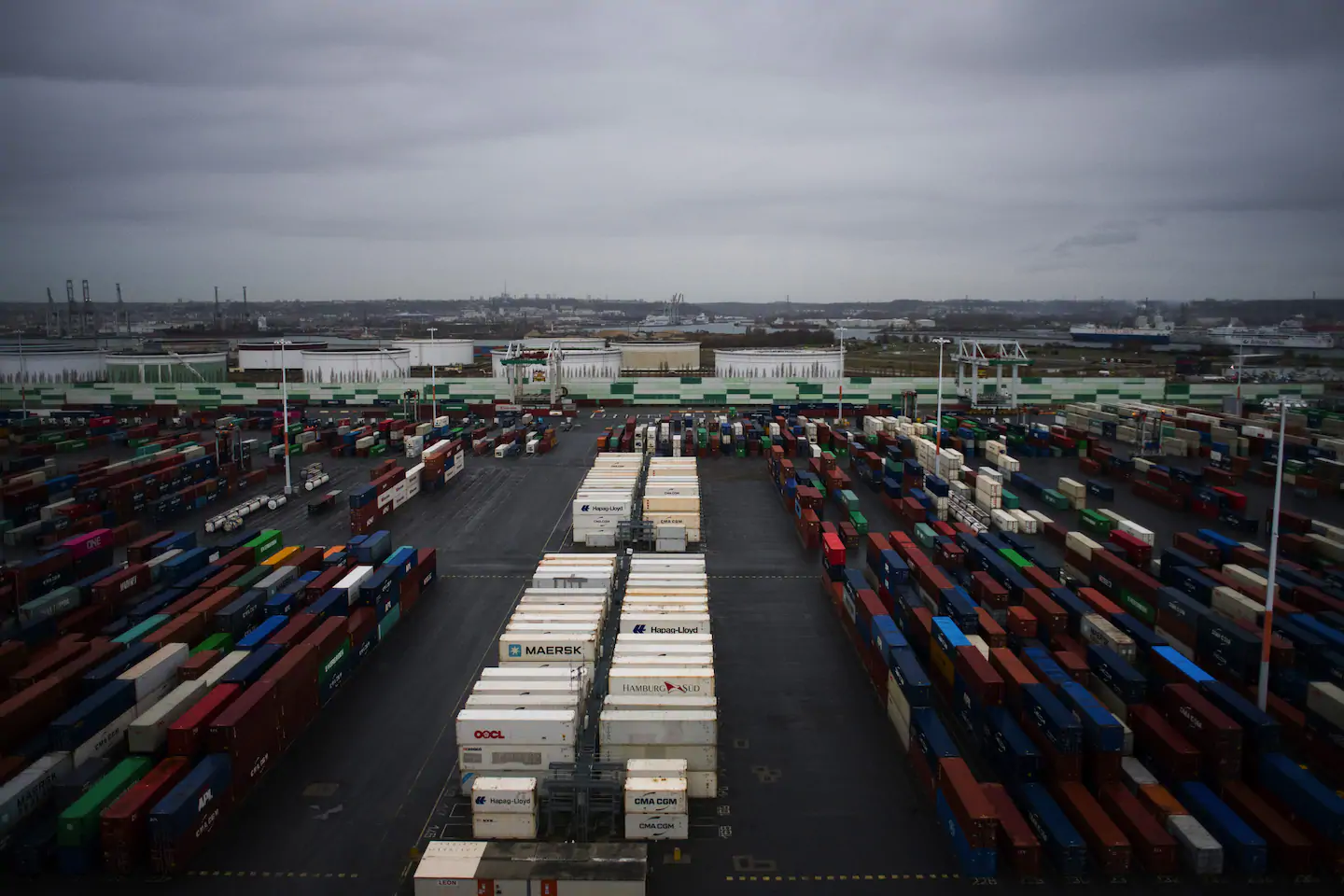

That abrupt and unprecedented spending shift has upended long-standing trade patterns, causing bottlenecks from the gates of Chinese factories to the doorsteps of U.S. homes.
The commercial disorder is just the latest blow to globalization’s finely tuned engine, capping more than a decade of financial crisis, trade wars, contagion and recession. Each shock has triggered swings in the flow of cash and goods through the $91 trillion global economy. But reverberations from the pandemic are exposing vulnerabilities in the physical plumbing of cross-border commerce that may linger, according to exporters, port officials and trade specialists.
“It’s crazy. Prices are at record highs. Multiple things are happening all at once,” said Phil Levy, an economist with Flexport, a San Francisco-based freight forwarder. “People work off of expectations. But now there’s just so much uncertainty.”
At the Port of Los Angeles one day last week, 42 ships were anchored offshore, waiting to unload their cargoes, even as every warehouse within 60 miles was already full. A shortage of dock workers amid California’s worsening coronavirus outbreak is further complicating operations; inbound cargo volumes in December were more than 23 percent higher than one year earlier.
“Some areas of the supply chain need to be sharpened,” Gene Seroka, the port’s executive director, said. “People are a little bit on edge.”
It’s a global problem, and it may get worse before it gets better. More than one-third of the containers transiting the world’s 20 largest ports last month failed to ship when scheduled, according to Ocean Insights, a data provider.
Glimmers of sticker shock are starting to vex corporate planners. The cost of imported industrial supplies jumped 4.2 percent in December and is up 27 percent since April’s pandemic low, with manufacturers complaining of shortages of materials such as steel.
Shipping issues are affecting familiar brand names such as the Gap, where an executive recently told investors that “port issues” were hamstringing operations. At WD-40, higher freight and warehousing costs dented profit margins last quarter, Jay Rembolt, the chief financial officer, told investors this month. Bang & Olufsen, a maker of music systems and televisions, said it had resorted to more expensive airfreight to compensate for a lack of seaborne options.
“These challenges have put inflationary cost pressures on our and many businesses and, as the market is anticipating, will put further inflationary pressure on transportation rates in 2021,” said Shelley Simpson, chief commercial officer for J.B. Hunt Transport Services, on a recent earnings call.
Consumers already have seen an impact with spot shortages of household appliances and some clothing items in recent months. The price of goods arriving from China posted its largest one-month gain in more than three years last month, rising by 0.3 percent. Overall, prices of imported goods rose 0.9 percent, their largest rise since August.
By themselves, shipping cost spikes are likely to have only a modest effect on inflation, according to Neil Shearing, chief economist for Capital Economics in London. But they will reinforce the effects of other factors, such as oil prices and ample fiscal and monetary stimulus, that are expected to drive the current 1.4 percent inflation rate higher, at least for a while.
“All of these temporary factors come together at the same time the market narrative is primed for a post-covid inflation surge,” Shearing said.
As the pandemic rippled across the globe last year, it interfered with typical seasonal patterns of global production and distribution. Factories closed, first in China and then elsewhere, as the world slipped into recession.
Shipping carriers initially idled vessels to match reduced demand. But as consumers stuck at home began buying desks, computers, backyard fire pits and entertainment systems — and Chinese factories resumed normal operations — Asian exporters clamored for space aboard cargo ships.
The sudden changes played havoc with supply chains that were designed to operate on “just in time” principles, bringing goods to ports when vessels were waiting to whisk them to distant customers.
But the surge in demand overwhelmed the system.
Fewer ships arriving in U.S. ports meant fewer shipping containers available for the return trip to Asia. With department stores and other retailers closed by shutdowns, goods piled up at port terminals and stateside warehouses. That made it harder for 18-wheelers to get into such facilities to pick up new loads and drop off empty containers, further clogging logistics channels.
Months later, ports and cargo carriers optimized for traditional trade flows continue to struggle with the resulting dislocations, even as shipping companies have rushed to return capacity to busy transit routes.
“It seems to be getting worse, not better. I don’t see this ending any time soon,” said Nate Herman, senior vice president for policy at the American Apparel and Footwear Association.
Last year’s stop-and-go global economy effectively shifted 5 million shipping containers from the first half of the year to the second half — on top of customary trade flows, said Lars Jensen, chief executive of SeaIntelligence, a Copenhagen-based consultancy.
“It’s multiple different bottlenecks all at the same time,” Jensen said. “It’s like a train wreck in slow motion.”
At the nation’s busiest container port, officials in Los Angeles have seen cargo volumes soar and plunge in dizzying cycles. Inbound shipments fell in the first months of the pandemic before roaring back to life in August.
Average monthly import volumes in the second half of 2020 were more than 50 percent greater than during the first six months of the year, according to Seroka, the port’s executive director.
Since there is more demand to send goods from China to the United States than to ship in the other direction, ocean carriers — after delivering their cargoes to Los Angeles — are refusing to wait for their containers to be reloaded with U.S. exports before returning them to China.
In December, the port processed about 2.5 times as many empty containers headed to China as full ones.
“It is simply a matter of supply and demand,” Seroka said.
That practice has irked American farmers, who say the shippers’ refusal to bring containers into the heartland is raising their costs and causing them to lose overseas sales of soybeans, grains and lumber. A coalition of agricultural exporters wrote to Biden transition officials this month complaining of “supply chain dysfunction” and backing an ongoing Federal Maritime Commission probe of shippers’ behavior.
The World Shipping Council, representing the cargo carriers, said the industry is doing its best. But “no part of the supply chain is geared to managing the extremes currently occurring,” it said this month.
Even as the carriers rush containers to Asia, some companies in China are struggling to get their U.S.-bound products out of the country. Manufacturers of specialized products such as fireworks are paying twice per container what they were a few months ago.
“Even paying the high price, we can’t get all the containers we need. We can only get a small percentage,” said one executive in China, who spoke on the condition of anonymity to preserve relationships with Chinese shippers.
This executive fears that up to 40 percent of his annual production will be stranded in China. That shortfall will ripple through to the company’s U.S. distributors, denting their profits and potentially confronting consumers with shortages for July 4.
Problems getting Asian goods through West Coast ports are crimping the rebound in U.S. manufacturing, and the situation is getting worse. In December, factories recorded “minimal gains in inventory levels and difficulties in expanding imports. Supply chains continue to struggle compared to November,” the Institute for Supply Management said in its monthly report.
The group noted that 16 industries reported that supplier deliveries were slowing and no industry reported improvement.
James Keane, chief executive of Steelcase, told investors last month that the office furniture manufacturer was facing an “acute shortage of steel” amid ongoing shipping constraints.
“There is [a] shortage of containers on the water, and then even in domestic shipping there [are] shortages of drivers, shortages of carriers and therefore upward pressure on fleet costs,” he said.
Many companies, frustrated by soaring shipping costs, blame the problems on the ocean carriers, saying they deliberately idled vessels last year to raise prices. But while the number of “blank sailings,” or canceled routes, did rise last year, carriers have increased their total capacity, Larsen said.
On the key trans-Pacific route, he said, capacity is up 30 percent from one year ago. It’s just that demand has risen even more.
Whatever the problems at sea, they are matched by those ashore.
In Los Angeles, Seroka is offering financial incentives for trucking companies to pick up and drop off their loads more quickly. The 93-minute average turnaround time should be more like 25 minutes, he said.
Seroka would also like to see the federal government take steps to make U.S. exports more competitive, thus making trans-Pacific trade more evenly balanced.
Still, the supply chain disruptions are likely to continue until the pandemic wanes and consumer buying patterns return to normal, analysts said.
“There’s only one thing that can fix this,” Jensen said, “and that’s time.”
Recent Comments