


The supply chain disruptions of 2020 were a wake-up call for manufacturing. With border closures, shipping delays, and shuttered facilities, new ways of meeting critical needs emerged. Some of those stop-gap measures were a temporary band-aid for a quick save, but others will have more staying power, especially for notoriously complex supply chains. Additive manufacturing (AM/3D printing) has been on the rise for years now as a manufacturing solution — and the pandemic has served for many to take a second first look at 3D printing.
Among the companies seeking to drive long-lasting change in the shape of supply chains via additive manufacturing is Xerox
XRX
HPQ
Xerox 3D Printing
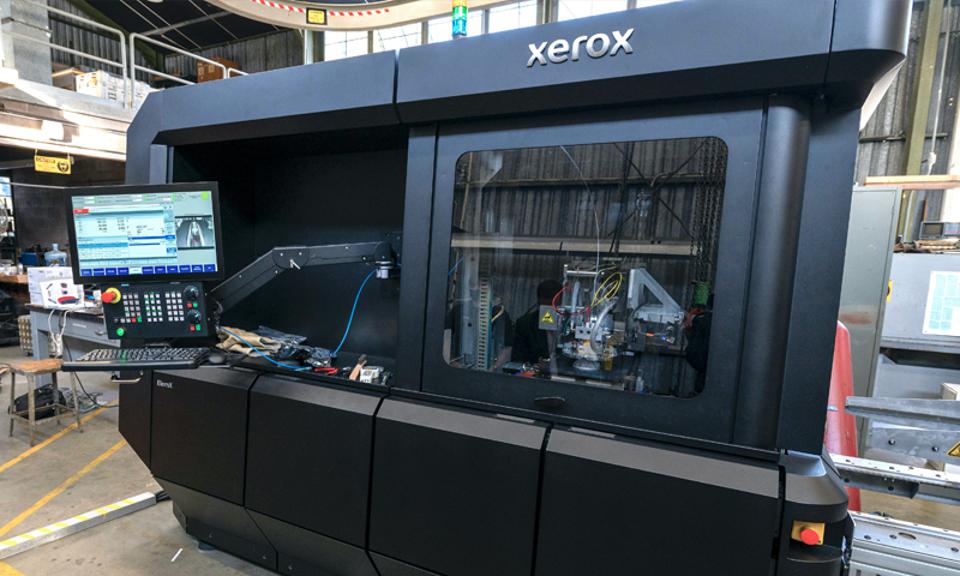
The Xerox ElemX 3D printer in place at its first installation at the Naval Postgraduate School, … [+]
Xerox
Last week, Xerox formally introduced its ElemX metal 3D printer as well as its first installation and collaborative partner. A conversation with Tali Rosman, Xerox Vice President and General Manager of 3D Printing, offers more insights into what this technology has to offer — and how a collaboration is set to reshape complex military supply chains.
Rosman first entered the 3D printing industry seven years ago, drawn to some of the technology’s benefits. “I looked at why people use 3D printing, such as enabling low-volume production and design freedoms; for me, though, a lot of the draw was direct manufacturing. You don’t need the tooling and the mold, you can make the part when you need it without all that setup, to oversimplify. To me,” she said, “that always led to spare parts and the supply chain.”
The dots Rosman connected seven years ago are now coming together more tangibly as adoption rises. Whether as a default or backup solution in manufacturing, 3D printing offers a sense of continuity for operations. “Often it still makes sense to make a part with metal casting, but now when there’s a global pandemic, a trade issue, or a supplier limit for whatever reason, knowing you have this alternative option to get the part, it just makes sense to me to use 3D printing for it,” she noted. Drawing from her background in software, where “everyone has a plan with backup servers,” Rosman sees 3D printing as a way for physical backups against a fragile supply chain structure.
That perception informs her leadership at Xerox, where the team is ensuring that the 3D printing solutions they create have real-world value. Prior to courting any market opportunities, internal engineering teams “ate their own dog food” to develop in-house use cases. A bracket for a 15-year-old digital press required replacement, but the original supplier had ceased production of the low-volume part. With a vested interest in ensuring continuous operation for the high-end 2D printing press, the Xerox team found sufficient motivation to develop a creative solution for the requisite replacement part.
The part more than proved out the ElemX: 3D printed in four hours, the new bracket saved Xerox 21% of the cost and saved 43% on CO2 emissions as compared to traditional metal casting. The bracket had for 15 years been created via metal casting, so that was the benchmark. But to prove the new metal 3D printing system’s mettle, the team also benchmarked it against competitive powder bed fusion 3D printing technology. Compared to that process, the bracket off the ElemX system was 38% less expensive and produced at a 40% reduced cycle time. Xerox is now reviewing other parts for potential production on its 3D printer, again a strategy quickly becoming familiar with 2D printing companies moving into 3D printing.
Looking beyond Xerox, the ElemX is intended to fulfill similar need-it-now parts demand in industries “where the absence of a spare part is very painful, where shortening that turnaround from weeks to days, or even hours, is very valuable,” Rosman said. The team is targeting usage in the aerospace and defense, automotive, heavy machinery, and oil and gas industries. These are all areas that use and replace metal parts, generally sourced via complex supply chains. And few supply chains are so complex as those found among the armed forces.
Xerox And The Naval Postgraduate School

The ElemX metal 3D printer in use at NPS.
Xerox
Xerox has announced a Collaborative Research and Development Agreement (CRADA), with the Naval Postgraduate School (NPS). To kickstart the relationship, NPS received the first ElemX customer installation in December.
While metal 3D printing is quickly building up case studies highlighting its here-and-now capabilities, many of the most impactful use cases are still years in the future. But they’re coming. Rosman noted that in discussing possibilities with NPS, the two entities were “using similar language in talking about the vision. And it is a vision; it will be a few years before we’re seeing 3D printers on ships for inventory. We needed a partner who was forward-thinking, like NPS, that could share both the vision and the work required to get there.”
“Our mission in Xerox 3D printing is to build resiliency and flexibility into the supply chain. The Army and Navy in particular have one of the most complex and mission-critical supply chains there are,” she added. “If we can help them, that gives us a lot of confidence in our ability to work with other customers as well.” This approach aligns with a common approach in additive manufacturing, where mission-critical applications in the aerospace, defense, and medical sectors tend to be established first, fully vetted and qualified, before trickling down to less-critical industries.
Familiarity between Xerox and the Navy also offered firm ground to begin this new work. There are already 2D printers from Xerox installed on US Navy ships, for example. “While 2D and 3D are very, very different, we can apply a lot of learnings from vibrations and quality needs from those installations,” Rosman added. Identifying the steps toward eventually placing an industrial metal 3D printer onboard a ship is key to adding this immediate access to spare parts. Rather than having to wait potentially weeks for vital components until the next port, sailors could load a 3D part file and produce exactly what they need in a way that has already been qualified for use in the exact geometry and material, on the exact machine, that they have at sea.
The US Army has been experimenting with just this idea, deploying 3D printers in the field. Relatively immediate access to spare parts could save a mission — could save soldiers’ lives. Employing this strategy throughout the armed forces could see notable improvements in mission success rates, while also reducing dependence on complex and fragile traditional supply chains.
Looking Ahead With Xerox 3D Printing

A metal part made on the Xerox ElemX 3D printer.
Xerox
Rosman and her team are remaining grounded in their high hopes for the future of additive manufacturing. Getting all the pieces into place — from internal expertise in jetting physics drawn from decades of 2D printing leadership to the company’s Palo Alto Research Centre (PARC) innovation hub and its software powering the ElemX to the Vader technology to process quality and reliability — has been quite an undertaking already. And, while they are eyeing ambitious applications that could streamline some of the most complex supply chains out there, Xerox is also well aware of the scope of impact for additive manufacturing.
“Today, 3D printing is maybe 0.1-0.2% of the global manufacturing pie,” Rosman explained. “It can get to 5%, maybe even 10% — which is 100x the size of the market today. But even if it’s 10%, that still means 90% of the market is not 3D printing. So we have to integrate into existing workflows, and not the other way around. We need to understand other companies and how their supply chains are managed, how their supply chain managers are thinking of supplies, costs, and timing.”
In-company use of additive manufacturing has been “extremely helpful” for the Xerox team to understand and navigate their own company’s supply chain complexities, as well as comprehending actual potential impact. While, for example, the digital press bracket is a stunning testimony to the power of a reengineered part, it is only one part in a complicated piece of industrial machinery. Such applications illustrate that “3D printing is ready for prime time,” as Rosman says, “and we appreciate the need to integrate into existing workflows and have to have a clear strategy in order to do that.”
As ever, 3D printing is a tool. It is not always the right tool for the job — but when it is, there could be hugely impactful significance to recognizing and adopting it. Finding the right applications where the benefits of 3D printing make sense is a tricky part of establishing it as a go-to tool in the toolbox.
Recent Comments